

Key Takeaways
Why intentional ownership costs less over time
Most household clothing budgets are not strained by big, deliberate purchases. They erode through small, repeated buys: a shirt grabbed because it was on sale, a duplicate item bought because the original could not be found, seasonal pieces purchased in bulk and barely worn. A capsule approach does not require spending more on individual garments. It requires buying fewer of them, on purpose.
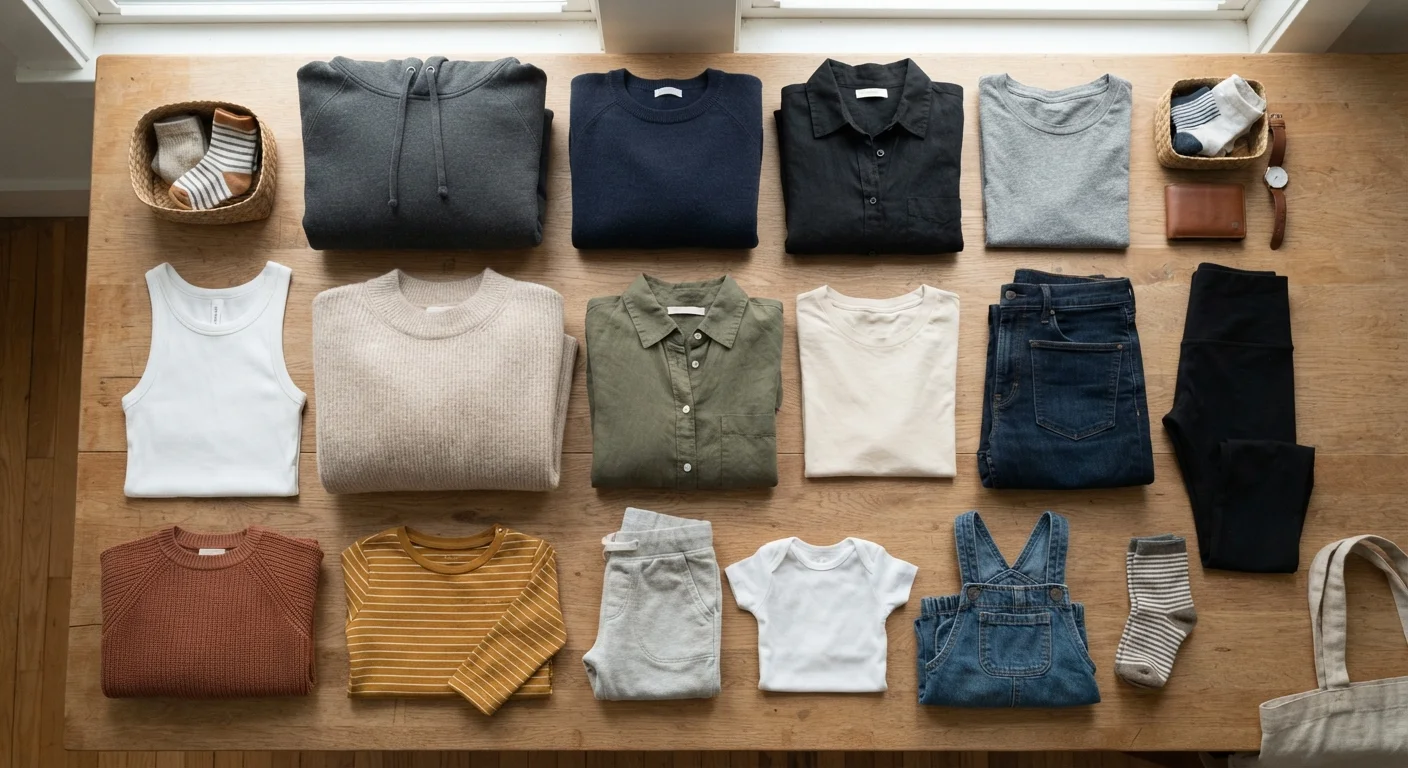
The core idea is simple: each person in the household owns a defined, limited set of clothing that covers all regular needs. Every item works with most other items. Nothing is kept out of guilt or inertia. When something wears out, it gets replaced. When a new item comes in, an old one leaves.
Families who travel regularly find a secondary benefit: packing becomes faster and luggage lighter. See our family packing guide for how a smaller wardrobe translates directly to fewer checked-bag fees.
The same discipline that trims a clothing budget applies to other household spending. If you find parallels with how your family approaches groceries, our piece on reducing food waste and grocery costs covers similar ground.
Donation bags or boxes
Hold clothing removed from rotation so it can be donated or resold rather than discarded.
Notebook or phone notes app
Track each family member's current inventory and identify genuine gaps before buying anything.
Slim, matching hangers
Uniform hangers make a small wardrobe easier to scan visually and save closet space.
Labeled storage bins
Store off-season items cleanly so they are easy to retrieve and assess next season.
How to build the capsule, step by step
The process below works for any family size. Work through one person at a time or tackle the whole household in a single weekend. Either approach is fine as long as you follow the sequence: audit first, then set targets, then buy only what is missing.
Pull everything out and do a full audit
Take every item of clothing for each family member out of storage at the same time. Lay it flat or hang it so you can see the full picture. Count duplicates, note what no longer fits, and identify anything that has not been worn in the past year. This step tends to reveal that most families already own more than they use.
Sort into keep, donate, and store piles
Once everything is visible, sort each item into one of three groups: keep (fits, worn regularly, in good condition), donate or sell (no longer fits or used), and store (seasonal items that will rotate back in). Be firm with the donate pile. Keeping clothes "just in case" is what caused the original clutter.
Define a target number of pieces per category
A practical capsule for an adult typically includes around 7 to 10 tops, 4 to 5 bottoms, 2 outerwear pieces, and enough underwear and socks to last a week without laundry. For children, scale down because growth spurts make large quantities wasteful. Write these targets down. Having a specific number makes future shopping decisions automatic: if you are already at the limit, you replace rather than add.
Identify real gaps before spending anything
Compare the keep pile against your targets. Note only what is genuinely missing, not what would be nice to have. A child who has six long-sleeve tops but no waterproof jacket has one gap. Write that gap down. This list becomes your only shopping authorization. Anything not on the list stays off the cart, regardless of price.
Fill gaps using resale sources first
Before buying new, check resale options for each item on your gap list. Thrift stores, consignment shops, and neighborhood resale groups often carry lightly used basics at a fraction of retail cost. Children's clothing in particular holds up well secondhand because kids frequently outgrow items before wearing them out. For guidance on what to look for and what to pass on, see our guide to buying used goods.
Set up a seasonal rotation system
At the end of each season, swap stored items back in, reassess the keep pile, and repeat the gap-fill process. Children typically need a reassessment every 6 months as they grow. Adults can often go a full year between major reviews. Label bins clearly with the season and size so the process takes minutes rather than hours next time around.
If you are also applying the capsule idea to beauty and personal care, our capsule makeup bag guide covers the same principles for a different category.
Common points where families get off track
The audit step is where most families stall. Sorting through everyone's clothing at once feels overwhelming, so it gets postponed indefinitely. Breaking the task into one drawer or one person per session makes it manageable without losing momentum.
The other frequent problem is treating the target number as a floor rather than a ceiling. If the target is eight tops and you currently have five, that means you need three more, not that you are free to buy as many as you like until you feel you have enough. Write the number down and treat it as a firm limit.
Children's capsules require more frequent reassessment than adults', but they do not require larger ones. Buying more to account for growth usually means buying things in sizes that will be outgrown before they are worn out. Buying one size up in secondhand shops is a more efficient approach. For more on getting value from secondhand purchases across different categories, see what families should know about buying used goods.