

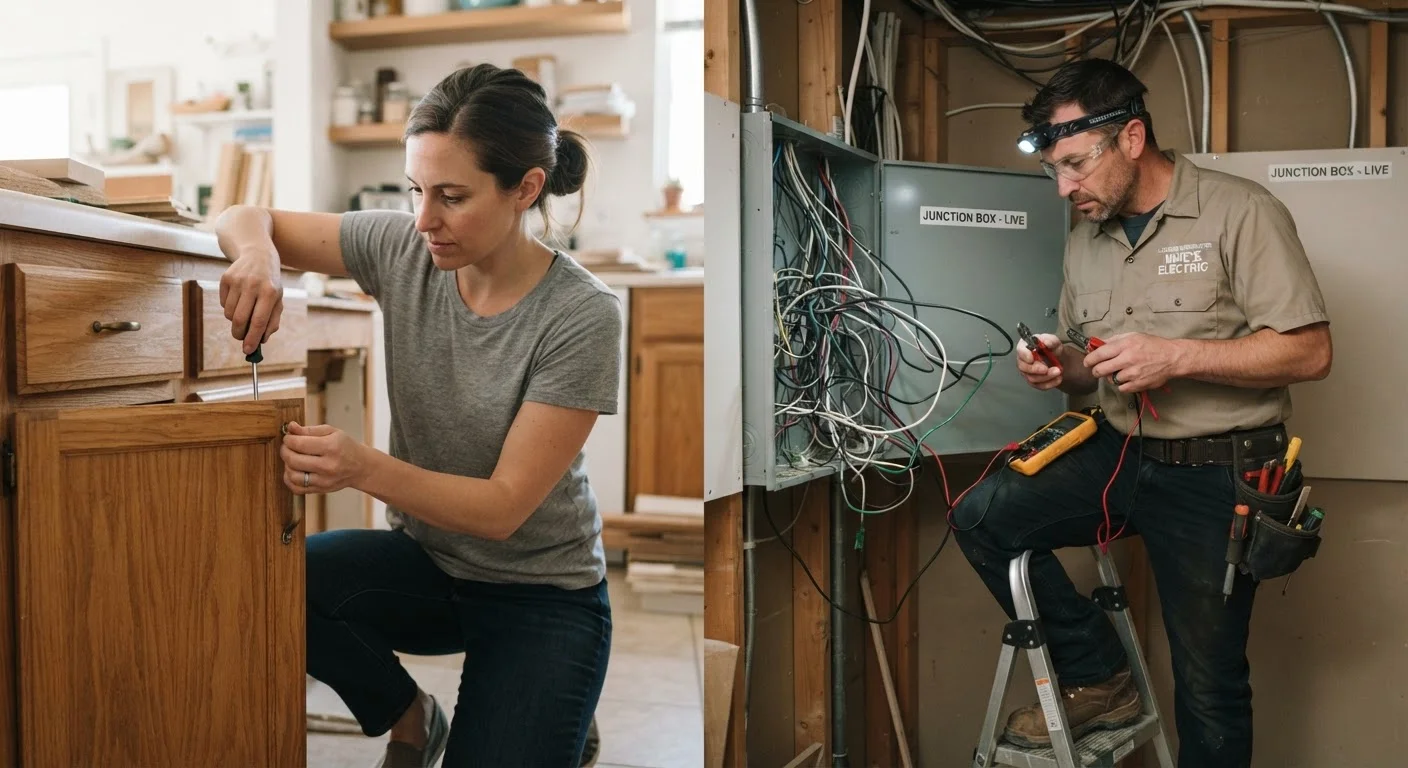
Key Takeaways
Option A
DIY home repairs
The hands-on, cost-saving approach for capable homeowners.
Best for: Straightforward, low-risk tasks where labor costs outweigh materials and no permits or specialized skills are required.
Option B
Hiring a professional
The licensed, code-compliant route for complex or hazardous work.
Best for: Electrical, plumbing, structural, or roofing work where safety, permits, or liability are genuine concerns.
If you want to save money on routine maintenance tasks
DIY home repairs
Painting, caulking, patching drywall, and replacing fixtures are well within reach for most homeowners. Labor typically accounts for 50 to 70 percent of a repair bill, so handling these yourself produces real savings.
If the repair involves your electrical panel, gas lines, or load-bearing structure
Hiring a professional
These systems carry serious safety and legal risks. Errors can void homeowner insurance, fail inspections, or cause fires and structural failure.
If you are preparing a home for sale
Hiring a professional
Permitted, professionally completed work is easier to document for buyers and reduces the chance of issues surfacing during a home inspection.
If the job requires a tool you would use only once
DIY home repairs
Renting specialized tools keeps DIY costs low. See our guide to renting vs. owning rarely used items for a fuller breakdown.
Where the real cost difference comes from
When a contractor quotes a repair, labor often accounts for more than half the total. On a $400 drywall patch, for example, materials might run $60 to $80 while the rest covers time, overhead, and profit. That gap is where DIY saves money, but only when the work is genuinely within reach.
DIY costs include materials, any tools you need to buy or rent, and the time you spend. If a repair takes you three hours and a professional would finish in one, the labor savings may narrow once you factor in your own time at a realistic hourly value. Still, for recurring tasks like caulking windows, patching small holes, or replacing a faucet, the accumulated savings over several years are meaningful.
Professionals bring speed, warranty coverage on their work, and accountability if something goes wrong. On complex jobs, those factors have real dollar value. A plumber who installs a water heater incorrectly is liable for the damage; a homeowner who does the same work without a permit may find their insurer won't cover a resulting flood. Weatherproofing your home is one area where a mix of both approaches often works: homeowners handle caulking and weather stripping, while a contractor addresses insulation in hard-to-reach areas.
| Criterion | DIY home repairs | Hiring a professional |
|---|---|---|
| Labor cost | None (your own time) | 50-70% of total bill |
| Material cost | Full retail price | Trade pricing (often lower) |
| Tools required | Buy or rent as needed | Included in service |
| Permit handling | Homeowner's responsibility | Contractor typically manages |
| Work warranty | None | Usually 1-2 years on labor |
| Insurance liability | Homeowner assumes all risk | Contractor carries liability insurance |
| Code compliance risk | Higher without expertise | Lower with licensed trade |
| Best for | Cosmetic, low-risk repairs | Electrical, gas, structural, roofing |
Tasks that generally make sense for DIY
Cosmetic and maintenance work is where DIY pays off most consistently. Interior painting, replacing light switches and outlets (with the circuit breaker off), installing ceiling fans on existing wiring, grouting tile, patching drywall, and swapping out door hardware all fall into this category for most competent adults willing to learn the steps.
Home cleaning solutions are another area where DIY can cut costs without much risk. Our breakdown of DIY home cleaning products covers what actually works and what does not, which is worth reading before you stock up on ingredients.
The clearest signal that a task is DIY-appropriate: the consequences of a mistake are low-cost and reversible. A badly painted wall can be repainted. A cracked tile can be replaced. No permit is involved, no specialized licensing is required, and online instructions from credible sources (manufacturers, trade associations) are clear and detailed.
When hiring a pro is the financially smarter move
The calculus changes fast when safety, code compliance, or long-term liability enter the picture. Electrical panel work, new circuit installation, gas line repairs, and any structural modification (removing a wall, adding a load-bearing beam) require permits in most jurisdictions and, in many states, must be performed by a licensed contractor. Doing this work without permits can complicate a home sale and may void a homeowner insurance policy if a related claim arises.
Roof replacement sits in a similar category. The materials are heavy and the fall risk is genuine. Beyond safety, an improperly installed roof can cause water intrusion that goes undetected for months, turning a $8,000 job into a $20,000 mold remediation. The math on hiring a pro becomes straightforward once secondary damage is factored in.
A useful rule: if a repair requires you to pull a permit, that is a strong signal the jurisdiction considers the work complex enough to warrant professional oversight. Always check your local building department's requirements before starting any significant project, because codes vary by state and municipality.
35%
Average labor share of a plumbing repair bill
Trade industry breakdowns commonly show labor at 35-50% of plumbing job totals, with materials and overhead making up the remainder.
2x-3x
Cost multiplier when a failed DIY repair needs professional correction
Contractors frequently report that fixing an incorrectly completed DIY job costs more than the original repair would have, due to remediation and added complexity.
68%
U.S. homeowners who attempted at least one DIY repair in the past year
Home improvement industry surveys have consistently found that a majority of U.S. homeowners take on some DIY repair work annually.