

Key Takeaways
Our Verdict
No single product seals every draft. Caulk handles fixed cracks, foam fills deep or oddly shaped voids, and weatherstripping covers movable joints. Matching material to gap type determines whether a seal lasts years or peels away by spring.
| Best for | Recommended |
|---|---|
| Sealing fixed cracks around window frames, trim, and baseboards | Caulk |
| Filling large gaps around pipes, wiring penetrations, or framing voids | Expanding foam |
| Stopping drafts along door edges, operable windows, and attic hatches | Weatherstripping |
Why the material choice matters as much as the effort
Walk through most older homes with a lit incense stick on a windy day and the smoke will waver at surprising spots: the base of a window casing, where a dryer vent enters the wall, along the bottom sweep of a side door. Each of those leaks has a different cause and a different geometry, and the material that fixes one can fail completely at another.
Homeowners sometimes apply caulk to a door frame and wonder why drafts return within months. The door moves every day; caulk does not flex enough to survive that. Others press foam backer rod around an operable window sash, where it compresses unevenly and tears. The material mismatch wastes time and money. Understanding what each product is designed to do is the first step toward a seal that actually holds. For a broader look at where drafts fit into overall energy efficiency, see what every homeowner should know about weatherproofing.
When to reach for caulk
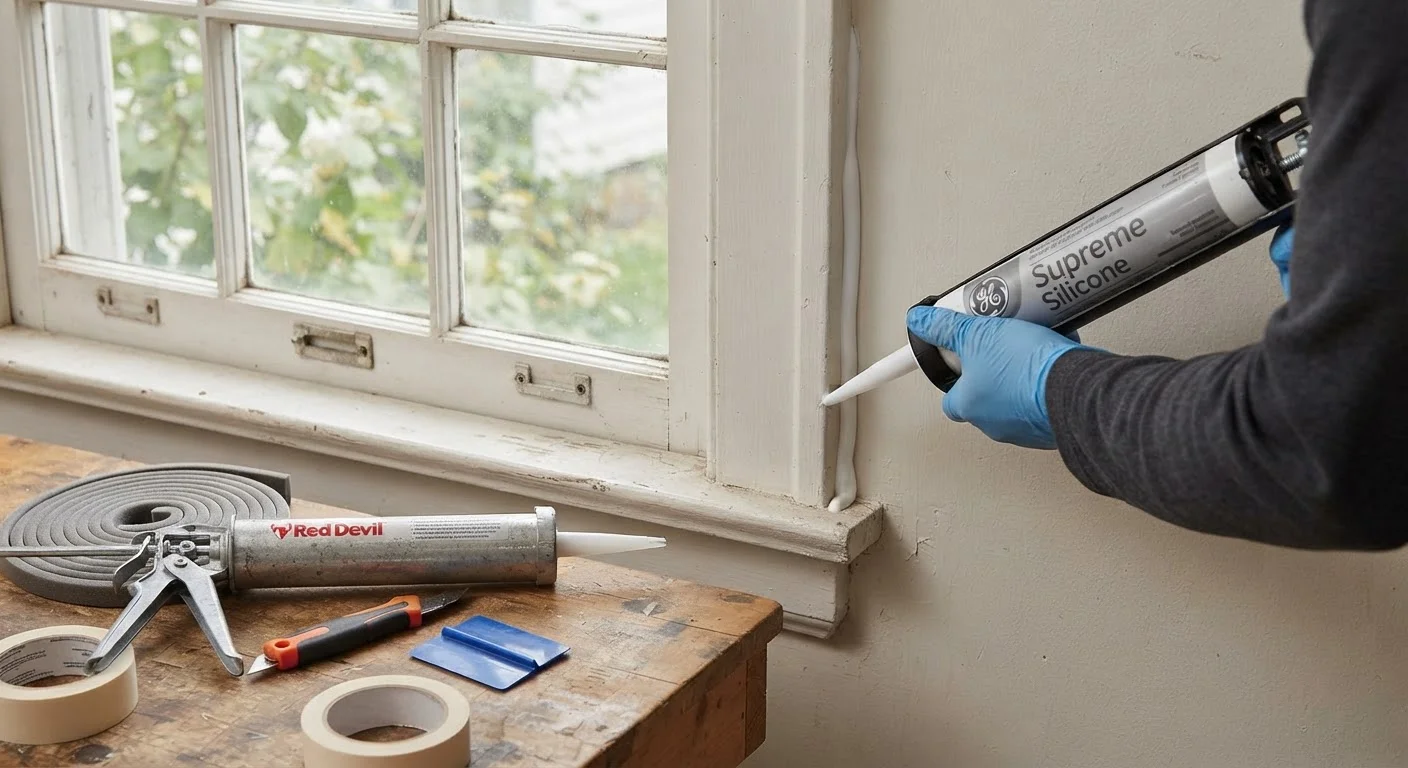
Caulk is a flexible sealant that bonds to two surfaces across a narrow gap and stays put as long as neither surface moves significantly. It comes in several formulations: silicone, latex (also called acrylic latex), and siliconized latex, which blends both. Latex caulk is paintable and easy to clean up with water, making it practical for interior trim work. Silicone resists moisture better and bonds to glass and metal reliably, so it suits exterior window perimeters and areas exposed to rain.
Good candidates for caulk include the joint where a window frame meets the surrounding drywall or wood trim, the seam between baseboard and floor, gaps where pipes pass through an interior wall, and the perimeter of a fireplace surround. The gap should be no wider than about half an inch; anything larger needs a backer material or a different product entirely.
Preparation matters more than most people expect. Caulk does not bond well to dust, old caulk residue, or painted surfaces that are peeling. Scraping the old material out, wiping the joint clean, and letting it dry fully before applying a new bead will extend the seal's life considerably.
Test for drafts before buying materials
Hold a lit incense stick or a thin strip of tissue near suspected gaps on a windy day. Movement tells you where air is entering before you buy anything. Map out the gap types across your home first, since you will likely need more than one product, and buying all three in small quantities costs less than buying large amounts of the wrong one.
When expanding foam makes sense
Expanding polyurethane foam, sold in spray cans, is best at filling three-dimensional voids that caulk cannot reach: the gap around a plumbing stack where it penetrates the subfloor, the cavity behind an electrical panel, the space around a recessed light fixture in an unconditioned attic. The foam expands to fill irregular shapes, then hardens into a rigid cell structure that blocks air and insulates moderately.
There are two general categories. Standard expanding foam grows substantially after application and can distort window or door frames if used in confined spaces around them. Low-expansion or "minimal-expanding" foam is formulated for those tighter areas and stays closer to its initial volume. Reading the label before buying prevents a messy problem.
Foam bonds permanently. Once cured, it cannot be pulled out cleanly, and it does not flex. Never apply it along a door stop or around a window sash that operates. Reserve it for penetrations and structural voids that will not move.
| Caulk | Expanding foam | Weatherstripping | |
|---|---|---|---|
| Best application | Fixed cracks and joints | Large voids and penetrations | Moving gaps (doors, windows) |
| Flexibility after cure | Moderate | Rigid | High (compresses and recovers) |
| Paintable | Latex types yes, silicone no | Yes after trimming | Varies by type |
| Typical lifespan | 5 to 10 years | Many years if protected | 1 to 5 years depending on type |
| Skill level required | Low to moderate | Low (use correct type) | Low |
| Main failure mode | Shrinks or cracks if gap moves | Wrong type distorts frames | Compresses permanently over time |
When weatherstripping is the right tool
Weatherstripping covers the gap along any surface that opens and closes: the four edges of an exterior door, the sash of a double-hung window, the pull-down attic stair, the access panel to a crawl space. Because the gap opens every time the door or window operates, the material must compress and recover without tearing or losing its seal.
Several types exist. Foam tape is inexpensive and installs quickly but compresses permanently over time and typically lasts one to three years under regular use. V-strip (also called tension seal) is a folded piece of plastic or metal that springs open to fill a gap; it handles the side channels of sliding windows well and lasts longer than foam tape. Door sweeps attach to the bottom of a door and drag lightly against the threshold, blocking the gap that appears when door frames rack slightly over time.
Fit is critical with weatherstripping. Too thin and air passes through; too thick and the door will not close or latch properly, putting stress on the hardware. Test with a dollar bill: close the door or window on it, and if the bill slides freely, the seal is inadequate.