

Key Takeaways
Start here
What INCI names actually are
Next
How ingredient order works
Then
Terms that signal formula type
Apply it
Reading labels on a budget
What INCI names actually are
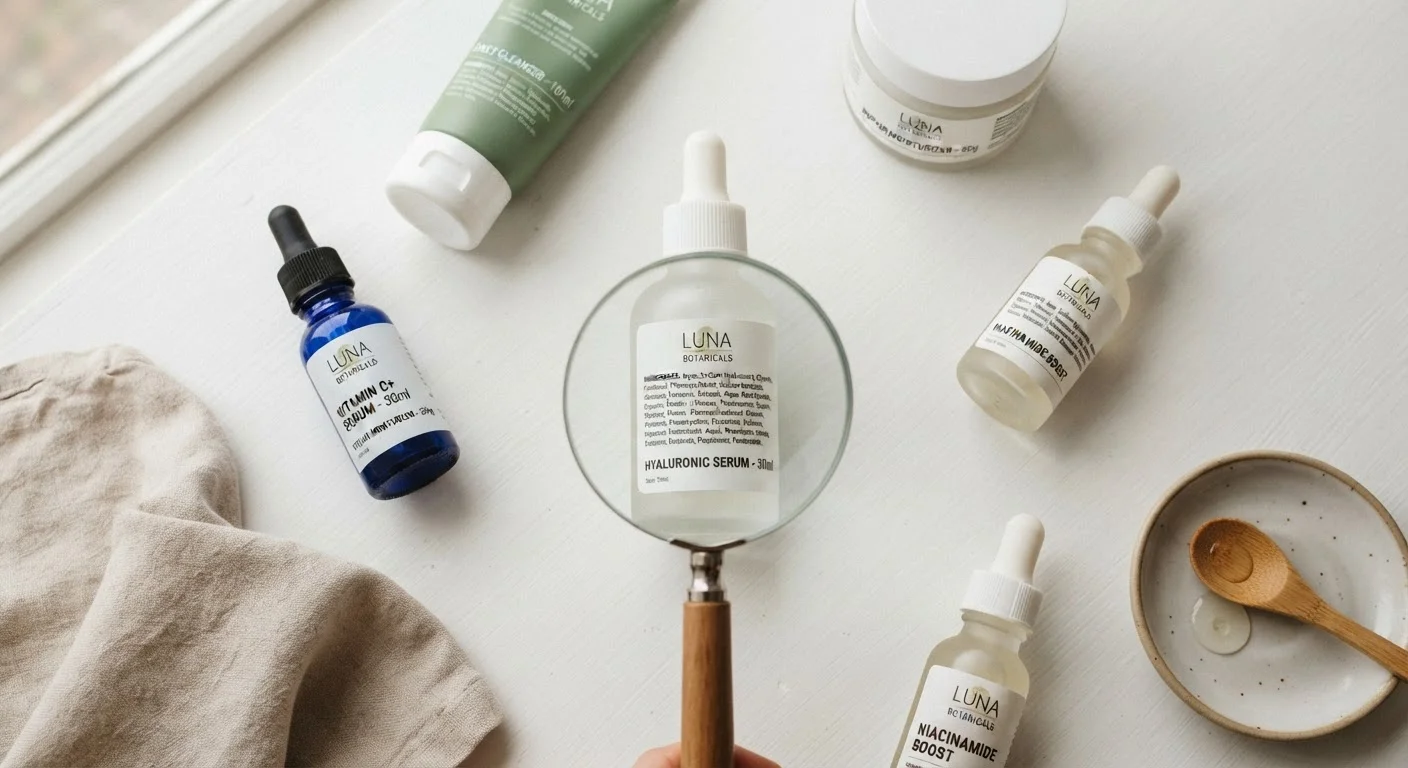
Every skincare product sold in the US must list its ingredients using the International Nomenclature of Cosmetic Ingredients system, commonly called INCI. These are the standardized Latin or chemical names you see on the back of a moisturizer or cleanser. The system exists so that an ingredient's name stays consistent regardless of which brand uses it or what country the product is sold in.
Water, for instance, appears as Aqua. Shea butter becomes Butyrospermum Parkii. Vitamin C shows up as Ascorbic Acid. Once you recognize a few dozen of these names, reading most everyday labels gets much faster.
INCI names are different from the marketing names brands use on the front of a package. A product might advertise a proprietary "youth complex" on its label while the actual INCI list shows a mix of peptides and humectants with no special status. The INCI list is the factual record; the front of the package is marketing copy.
How ingredient order works
US regulations require that ingredients appear in descending order of concentration, from the most to the least. Water is almost always first in a water-based formula because it makes up the largest share by weight. After that, you typically see emollients, thickeners, and then active ingredients lower down the list.
There is an important exception: once an ingredient is present at 1% or less, manufacturers are allowed to list those remaining ingredients in any order. This means that two ingredients sitting next to each other near the bottom of a list could have very different concentrations. A brand might list a popular active right after water to make it seem prominent, but if it falls after the 1% threshold, the actual amount in the formula may be small.
Knowing this rule helps when you compare two products. If a key ingredient appears in the top five on one product but near the bottom of another, the first formula likely contains more of it. That is useful information when you want to understand what you are actually paying for. For a closer look at which actives are worth seeking out in affordable formulas, see drugstore skincare ingredients worth your attention.
Terms that signal formula type
Several common words on labels carry specific technical meanings, and a few carry almost none at all.
Fragrance (or Parfum) is a legal umbrella term in the US that can cover dozens of undisclosed scent compounds, including some that cause reactions in sensitive skin. If you are managing sensitivity, this is one of the more useful things to scan for. Our guide on what 'fragrance-free' actually means on a beauty label walks through exactly why the distinction between 'fragrance-free' and 'unscented' matters.
Natural and clean have no legal definitions under US cosmetics law. The Food and Drug Administration does not define or regulate these terms for cosmetics, so any brand can use them. A product labeled 'natural' may still contain synthetic preservatives, and a product without that label may use only gentle, well-studied ingredients.
Preservatives are ingredients added to prevent microbial growth and extend shelf life. Phenoxyethanol, sodium benzoate, and various parabens are common examples. Preservatives are a functional part of any water-containing formula, and their presence is generally a sign that the product was formulated to stay safe over time.
pH adjusters like citric acid or sodium hydroxide appear on many lists but are usually present in tiny amounts to bring the formula to the right acidity level. Seeing them does not mean a product is acidic or alkaline in use.
Reading labels on a budget
Label literacy is one of the more practical tools for getting value out of a skincare budget. When you can read an ingredient list, you are better positioned to compare a $6 product with a $40 one and decide whether the difference in price reflects a difference in formula.
A few habits make this easier. First, look at where water and common thickeners (like glycerin or carbomer) appear relative to the active ingredient you care about. Second, note whether the active you want appears before or after preservatives, since preservatives tend to sit at or below the 1% line. Third, treat any front-of-pack claim as a starting point for investigation, not a conclusion.
Free ingredient databases are available online that translate INCI names into plain descriptions and flag common irritants, which can speed up the process considerably. How your skin responds to a formula over time is still the most reliable guide, but knowing what is in a product before you buy it reduces the risk of wasting money on something unsuitable.
If you are building or adjusting a routine, how skin needs shift over time offers useful context on which ingredient types tend to matter most at different life stages.