

Key Takeaways
Why kitchen masks are so appealing, and where the idea runs into trouble
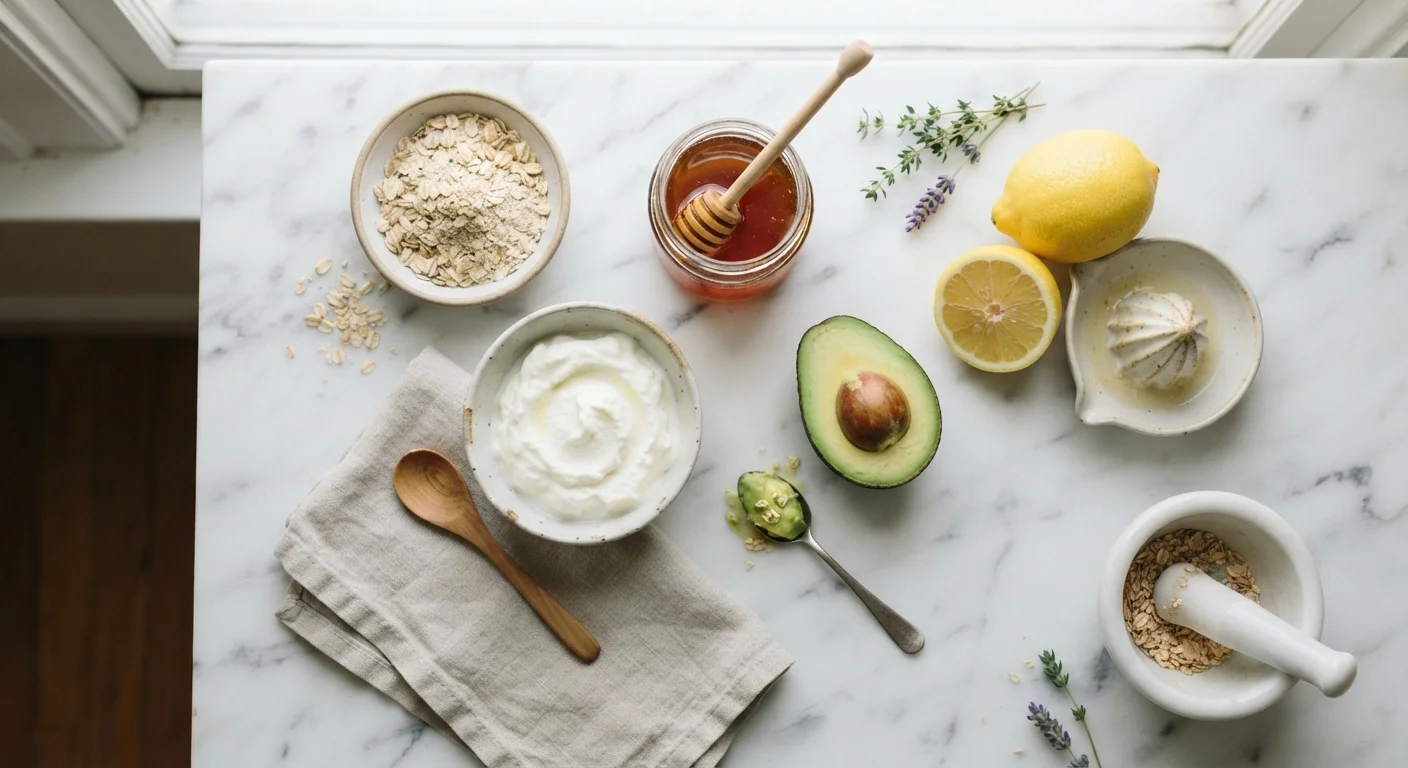
Honey, oats, avocado, lemon juice: the ingredients in a weekend face mask are often the same ones already sitting in your kitchen. The appeal is real. You avoid unfamiliar preservatives, you spend very little money, and the whole process feels pleasingly hands-on. That value-driven logic is not wrong in principle. The problem is that "natural" and "safe for skin" are not the same thing, and "cheap" does not always mean effective.
The skin barrier is a finely tuned system. When you apply an ingredient to your face, it does not behave the same way it does in a salad. pH, concentration, allergen potential, and particle size all change what an ingredient does once it contacts living skin. Understanding those variables is what separates a mildly useful home treatment from one that causes a rash or, in worse cases, a chemical burn.
For a grounding in what evidence-backed actives actually do, see which active ingredients in affordable skincare are worth your attention. That context helps when comparing DIY options to formulated products.
Myth
Lemon juice is a safe, natural way to brighten skin and fade dark spots.
Fact
Lemon juice has a pH around 2, which is acidic enough to damage the skin barrier and cause phototoxic burns when skin is exposed to sunlight afterward.
Citrus fruits contain compounds called furanocoumarins. When these contact skin and are then exposed to UV light, they can cause a phototoxic reaction: redness, blistering, and long-lasting hyperpigmentation. Ironically, this reaction can make dark spots worse, not better. Vitamin C does have brightening evidence behind it, but formulated ascorbic acid products are buffered to a skin-safe pH and tested for stability in a way that fresh lemon juice is not.
Myth
Applying egg whites to the face tightens pores and reduces their size.
Fact
Pore size is largely determined by genetics and sebum production. Egg whites create a temporary film that may feel tightening, but pores do not permanently shrink from any topical treatment.
The sensation of tightened skin after an egg white mask comes from the protein film drying on the surface. That effect disappears within minutes of rinsing. Beyond the cosmetic illusion, raw eggs carry a small but real risk of Salmonella contamination, and egg proteins are a common allergen. Anyone with an egg sensitivity can develop a contact reaction on facial skin, which is thinner and more reactive than the skin on hands or arms.
Myth
Coconut oil is an effective moisturizer for all skin types and works well as a face mask base.
Fact
Coconut oil is heavily comedogenic for many people, meaning it can clog pores and contribute to breakouts, particularly on the face.
Coconut oil rates high on most comedogenicity scales used by cosmetic chemists. For people with dry, non-acne-prone skin it may provide some occlusive moisturizing benefit. For anyone with oily or acne-prone skin, applying it to the face regularly raises the likelihood of clogged follicles. Its saturated fat profile makes it less suitable as a facial ingredient than lighter, lower-comedogenicity oils such as squalane or jojoba oil, which more closely resemble the skin's own sebum.
Myth
Turmeric masks are a proven treatment for acne and inflammation.
Fact
Curcumin, the active compound in turmeric, has anti-inflammatory properties studied in laboratory and oral supplement contexts, but evidence for topical DIY application on acne is very limited.
Most curcumin research involves oral intake or standardized topical formulations, not raw turmeric paste. Applying ground turmeric directly to skin also carries a notable cosmetic downside: it stains skin yellow-orange and can permanently discolor fabric, grout, and towels. People with sensitive skin may also experience contact irritation from turmeric's volatile compounds. If you want anti-inflammatory actives in your routine, formulated products with niacinamide or azelaic acid have a stronger and more consistent evidence base.
Myth
Sugar scrubs make an effective and gentle face mask or exfoliating treatment.
Fact
Sugar granules have irregular, sharp edges that can create micro-tears in facial skin, and physical scrubbing in general is considered too aggressive for most face skin by current dermatology guidance.
The movement toward chemical exfoliants in professional skincare reflects a growing understanding that mechanical scrubbing on the face can cause micro-damage, worsen active breakouts by spreading bacteria, and impair the skin barrier over time. Sugar granules dissolve somewhat with water contact, but not fast enough to prevent abrasion during scrubbing. On the body, where skin is thicker, sugar scrubs carry lower risk. For facial exfoliation, a diluted lactic acid product or a soft washcloth used gently is a more controlled approach.
Ingredients worth using carefully versus ones to avoid
Colloidal oatmeal (finely ground oats suspended in water) has a well-established record in dermatology. The U.S. Food and Drug Administration has recognized it as a skin protectant, and peer-reviewed studies confirm it can calm mild itch and irritation. Plain oats mashed into a mask are not the same thing as pharmaceutical-grade colloidal oatmeal, but a gentle oat paste is unlikely to cause harm for most people.
Raw honey has antimicrobial properties because of its low water activity and natural hydrogen peroxide content. Some small clinical studies have examined medical-grade honey for wound care, though those findings do not directly translate to using grocery-store honey as an acne treatment. The moisturizing effect of honey on skin is plausible and carries low risk for people without bee-product allergies.
Plain full-fat yogurt contains lactic acid, a well-studied alpha hydroxy acid. Lactic acid in formulated products typically appears at concentrations between 5% and 10%, with a controlled pH. Yogurt has a much lower and inconsistent concentration, so the exfoliating effect will be subtle. That inconsistency is actually a safety feature: you are less likely to over-exfoliate accidentally.
Baking soda is where many popular recipes go wrong. Its pH sits around 9, far above the skin's natural range of 4.5 to 5.5. Applying it disrupts the acid mantle, which can worsen acne and leave skin vulnerable to bacteria. Dermatologists broadly advise against using it on the face. The same caution applies to undiluted apple cider vinegar, which is acidic enough to cause chemical burns at full strength.
For a broader look at which professional techniques translate safely to a home setting, this guide to salon treatments you can realistically do at home covers the trade-offs honestly.
Undiluted acids can burn skin
Lemon juice, apple cider vinegar, and other undiluted acidic ingredients can cause chemical burns and phototoxic reactions when applied to facial skin. If you choose to use any acidic ingredient, always dilute it significantly and avoid sun exposure immediately after application. When in doubt, a formulated product with a tested and labeled pH is the safer choice.
How to approach DIY masking more safely
Patch testing is the most practical safety step. Apply a small amount of any new ingredient to the inner arm or behind the ear, wait 24 hours, and check for redness, itching, or swelling before using it on your face. This does not guarantee you will have no reaction, but it catches common sensitivities early.
Keep application time short. Ingredients sitting on the face for 20 minutes interact more aggressively with skin than a quick rinse-off. For anything acidic or enzyme-based, ten minutes is a reasonable ceiling if you are experimenting.
Avoid mixing multiple active ingredients in one batch. Lemon juice plus baking soda, for example, neutralizes the lemon's acid while leaving the pH volatile and unpredictable. Simpler is safer.
If you want to understand what is already working in your existing products, learning to read a skincare ingredient list gives you a clear starting point. That knowledge also helps you spot when a DIY ingredient overlaps with something your routine already contains, so you do not accidentally double up on exfoliation or active exposure.
This article is for general informational purposes only and is not medical or dermatological advice. If you have a skin condition, sensitivity, or reaction, consult a licensed dermatologist or qualified healthcare provider before trying new topical treatments.